




Anthropic at $350B: What It Means for Secondary Buyers
Anthropic is raising $25B at a $350B valuation, according to the Financial Times and Bloomberg. Four months ago, it was $183B. Ten months ago, $61.5B.
Forget the Sequoia drama (they're backing all three frontier labs now—taboos are for slower markets). The question for secondary participants is simpler: what happens to pricing from here?
The math that matters:
Before this round, secondary shares were trading around $150-175/share, according to Caplight data—roughly in line with Anthropic's September valuation of $183B. Today, secondary pricing has climbed to approximately $300/share.
Sellers who were willing to transact at $165 last month have little incentive to accept that price now. Secondary pricing typically adjusts upward following major funding rounds as sellers recalibrate expectations—and that adjustment is already underway.
The pattern to watch:
This is the third Anthropic repricing in under a year. Each round has compressed the window between funding events. The company reportedly hit $9B ARR in 2025 and is targeting $20B this year, according to Reuters. At those numbers, the $350B valuation seems to imply ~13-17x forward revenue for a company growing 100%+ annually, according to an analysis from AI CERTs.
What the velocity tells us:
$61.5B to $350B in ten months is a 5.7x move. For comparison, SpaceX went from $137B to $800B over roughly 23 months—a 5.8x increase. Frontier AI is repricing at aerospace-scale velocity, and secondary markets are adjusting accordingly.
SpaceX IPO: What Secondary Holders Need to Know Now

SpaceX’s Starlink satellites in orbit (illustration).
Elon Musk confirmed IPO preparations last month, calling an Ars Technica report "accurate" in a post on X. The target window is mid-2026. Current implied valuation: $800B, per a shareholder letter reviewed by Reuters.
For anyone holding SpaceX secondary shares—or considering a position—here's the calculus:
The upside case:
- IPO at $1T+ (some bankers are modeling $1.5T, according to CNBC)
- December tender price of $421/share becomes the cost basis for potential gains
- Public liquidity means holders can actually exit positions
The risk case:
- IPO slips to 2027 (SpaceX has delayed liquidity events before)
- Public markets don't pay private market multiples (see: Figma's post-IPO compression from $143 to ~$37)
- Lock-up periods typically freeze holders for 6 months post-listing
The risk calculus: With an IPO potentially 6-12 months away, the investment thesis shifts. Buyers are likely no longer underwriting to a long-term private hold—they're underwriting to an exit event. That's a different bet, with different risk parameters: tighter timeline, more binary outcome, and valuation dependent on public market appetite for mega-cap tech.
The Starlink variable: SpaceX isn't primarily a rocket company anymore. Starlink generates roughly 70% of revenue, per industry estimates, with 9M+ subscribers and the recent $17B EchoStar spectrum acquisition enabling direct-to-cell service. The IPO story is "space-enabled telecom infrastructure," not just "launch services." That framing affects how public markets may value the company.
Quick Takes

Sequoia joins Anthropic's $25B round, now backs all three frontier AI labs — The storied VC firm is breaking with tradition by investing in Anthropic alongside existing stakes in OpenAI and xAI. The move signals how top investors view the AI race: not as winner-take-all, but as a market big enough for multiple giants.
OpenAI begins testing ChatGPT ads in the U.S. — Free users and the new $8/month "Go" tier will see sponsored content at the bottom of responses. Paid tiers remain ad-free. The shift marks a major monetization pivot as OpenAI diversifies revenue ahead of a potential IPO.
Ripple rules out IPO despite $40B valuation — CEO Monica Long confirmed the company sees no strategic need for a listing after its late-2025 private raise. A notable counter-narrative to the IPO rush.
VCs expect bigger rounds, fewer winners in 2026 — Capital concentration at the top continues. In secondary markets, this dynamic tends to make high-profile names more competitive while the long tail sees thinner liquidity.
Augment Nominated for the 2025 SecLink Awards
Augment was nominated for the 2025 SecLink Awards, recognizing the most influential players in the secondary market. We’re honored to be included alongside firms shaping the future of private market liquidity.
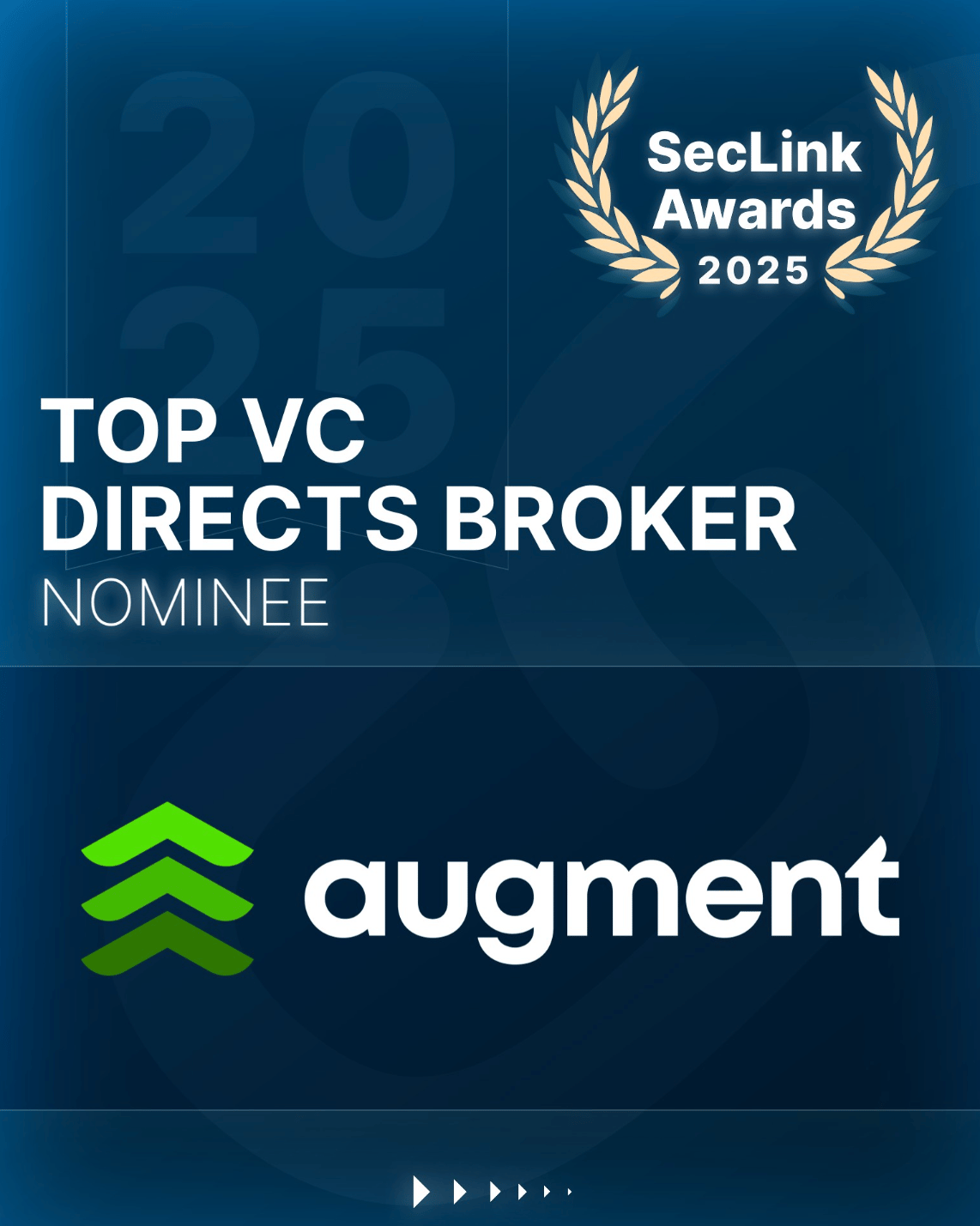
Voting is now open and runs through January 25th.
Thanks to the SecondaryLink team and to everyone who has supported us this past year.
In The Wild

📖 The Manual
Right of First Refusal (ROFR)
A contractual provision giving a company the option to purchase shares from a seller before those shares can be sold to an outside buyer. In most private company transactions, the standard ROFR period is 30 days—during which the company may exercise its right to buy the shares at the proposed price. ROFRs can add time and uncertainty to secondary transactions, but they also give issuers control over who joins their cap table. Read more →
🔭 What We're Watching
- Anthropic secondary repricing. Major funding rounds typically pull secondary pricing upward over 2-4 weeks as the market recalibrates. We'll be tracking whether that pattern holds here.
- SpaceX IPO timeline signals. Mid-2026 is the reported target. S-1 filing rumors and banker selection news would be the next milestones to watch. Each data point affects the risk/reward calculus for secondary positions.
- AI valuation dynamics. Anthropic at $350B affects how the market perceives OpenAI at $500B and xAI at ~$250B. These rounds set comps for each other, and secondary pricing across the frontier AI cluster tends to move in sympathy.
Related posts
View more



FOR ACCREDITED INVESTORS ONLY: Under federal securities laws, private market investments on this platform are available exclusively to Accredited Investors. Verification of status required before investing. Private investments involve significant risks including illiquidity, potential loss of principal, and limited disclosure requirements. "Augment" refers to Augment Markets, Inc. and its affiliates. Augment Markets, Inc. is a technology company offering software and data services, in addition to financial products and services through its wholly-owned but separately managed subsidiary, Augment Capital, LLC. Securities are offered by Augment Capital, LLC, member of FINRA / SIPC.